Vacuum Cleaner OEM Manufacturing: A Complete Guide for Brands & Distributors
For brands, distributors and retailers developing their own floor care products, choosing the right manufacturing model is an important part of turning a product concept into a commercially successful vacuum cleaner.
OEM vacuum cleaner manufacturing allows a buyer to work with an experienced manufacturer to produce vacuum cleaners according to defined product specifications, design requirements, performance targets and brand standards.
Depending on the project, OEM manufacturing can range from modifying an existing product platform to developing a highly customized vacuum cleaner with new tooling, components and technical specifications.
This guide explains how vacuum cleaner OEM manufacturing works, what can be customized, what buyers should prepare before approaching a manufacturer, and how to manage the project from initial concept to mass production.
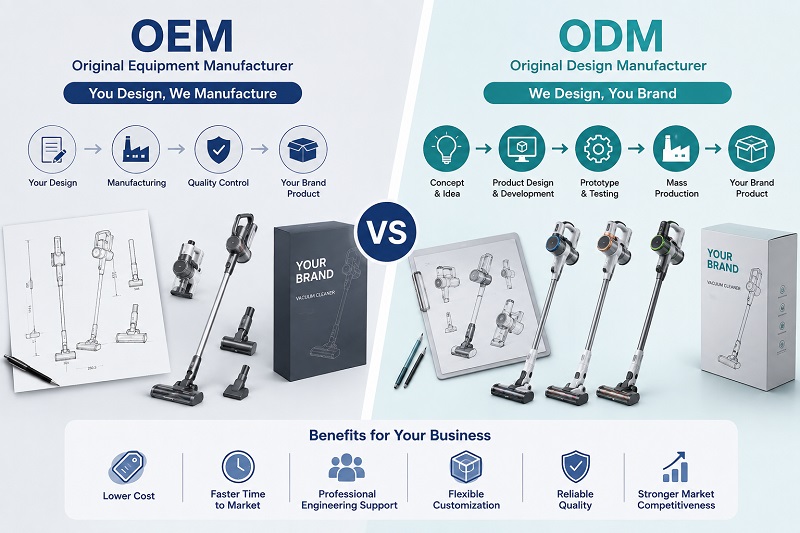
If you are still deciding whether OEM or ODM is more suitable for your project, read our OEM vs ODM Vacuum Cleaner guide.
What Is OEM Vacuum Cleaner Manufacturing?
OEM stands for Original Equipment Manufacturer.
In a vacuum cleaner OEM project, the buyer normally defines the product requirements while the manufacturer provides the engineering, sourcing and production capabilities needed to manufacture the product.
Depending on the project, the buyer may provide:
- Product concept
- Industrial design
- Technical specifications
- Performance targets
- Product dimensions
- Motor requirements
- Battery requirements
- Accessory requirements
- Branding guidelines
- Packaging requirements
- Target market and compliance requirements
The OEM manufacturer then evaluates whether these requirements can be manufactured reliably and economically.
For some projects, an existing product platform can be modified. For others, new components, tooling or engineering development may be required.
Who Should Use OEM Vacuum Cleaner Manufacturing?
OEM manufacturing is particularly suitable for companies that already have a relatively clear idea of what they want to develop.
Typical OEM customers include:
- Established vacuum cleaner brands
- Home appliance brands
- Floor care brands
- Importers
- Distributors
- Retail chains
- E-commerce brands
- Companies expanding into floor care appliances
OEM can be especially useful when a company already has its own product concept, specifications or brand requirements but does not want to operate its own manufacturing facility.
For companies looking for a faster market-entry solution using an existing product platform, private label manufacturing may be another option.
OEM vs Private Label Vacuum Cleaners
Although OEM and private label manufacturing are related, they are not always the same.
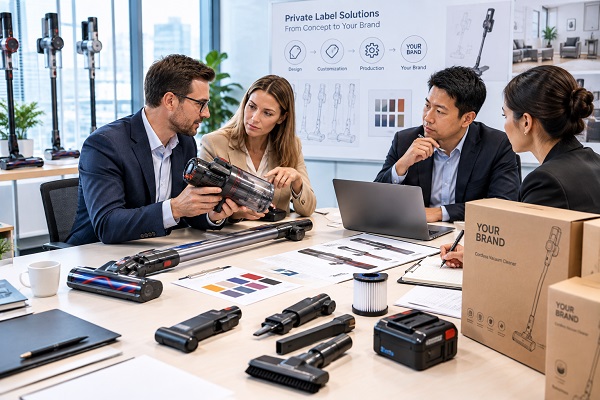
A private label project typically starts with an existing manufacturer's product. The buyer adds its own logo, packaging and selected customization.
OEM manufacturing can involve significantly deeper customization.
| Factor | Private Label | OEM Manufacturing |
|---|---|---|
| Existing product platform | Usually | Optional |
| Brand customization | Yes | Yes |
| Packaging customization | Yes | Yes |
| Technical customization | Limited to Medium | Medium to High |
| Structural changes | Usually limited | Possible |
| New tooling | Usually not required | May be required |
| Buyer specifications | Limited | Important |
| Product differentiation | Low to Medium | Medium to High |
The appropriate model depends on your market strategy, development budget, expected volume and required level of product differentiation.
What Types of Vacuum Cleaners Can Be Manufactured Through OEM?
OEM manufacturing can be used for many floor care product categories.
Cordless Vacuum Cleaners
Cordless vacuum cleaners are one of the most common categories for OEM development.
Possible areas of customization include:
- BLDC or other motor configurations
- Suction performance
- Battery voltage and capacity
- Runtime
- Charging system
- Dustbin capacity
- Filtration
- Floorhead
- Accessories
- Product appearance
- User interface
For more information about evaluating cordless vacuum cleaner specifications, see our Cordless Vacuum Cleaner Buying Guide.
Corded Vacuum Cleaners
OEM corded vacuum cleaner projects can focus on:
- Motor power
- Suction performance
- Product dimensions
- Dust collection
- Filtration
- Cord length
- Floorhead
- Accessories
- Product appearance
Corded products can be particularly suitable for markets where continuous cleaning performance and competitive pricing are important.
Wet & Dry Vacuum Cleaners
Wet & dry vacuum cleaner OEM projects may require consideration of:
- Tank capacity
- Usable tank capacity
- Motor power
- Suction performance
- Wet and dry separation
- Blower function
- Wheels
- Accessory storage
- Hose design
- Filtration
Spot Cleaners
Portable spot cleaner projects can be developed for applications including:
- Carpet cleaning
- Upholstery cleaning
- Sofa cleaning
- Car interior cleaning
- Pet stain cleaning
Important design factors include water tanks, suction performance, spray system, hose design and cleaning accessories.
Steam Cleaners and Steam Mops
OEM steam cleaning products may involve customization of:
- Heating system
- Steam output
- Water tank
- Cleaning head
- Accessories
- Cord length
- Product appearance
- Packaging
Mattress and Dust Mite Vacuum Cleaners
These products can be developed for mattress, sofa and fabric-surface cleaning.
Depending on the product, features may include:
- UV-related functions
- Motorized brush systems
- Filtration
- Dust collection
- Suction systems
- Heating or other functions
What Can Be Customized in an OEM Vacuum Cleaner Project?
One of the main advantages of OEM manufacturing is the ability to customize the product according to the buyer's requirements.
The level of customization depends on the product platform, technical feasibility, tooling investment and order volume.
1. Industrial Design and Appearance
Product appearance can play an important role in brand differentiation.
Depending on the project, customization may include:
- Overall product shape
- Housing
- Handle
- Dustbin
- Decorative components
- Surface treatment
- Product colors
- Brand identity
A completely new industrial design normally requires more development work than modifying an existing product.
2. Motor and Suction System
The motor is a key component of vacuum cleaner performance.
Depending on the product, manufacturers may evaluate:
- Motor type
- Motor power
- Motor speed
- Suction pressure
- Airflow
- Efficiency
- Noise
- Thermal performance
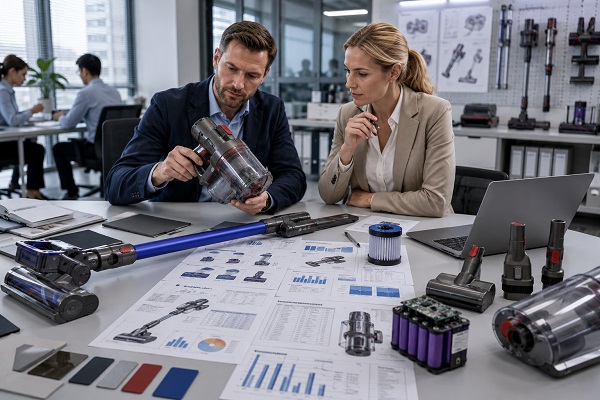
However, buyers should avoid evaluating a vacuum cleaner only by its maximum advertised Pa value.
Real cleaning performance depends on the complete system, including:
Motor + Airflow + Air Duct + Filtration + Floorhead + Brushroll
The product should therefore be evaluated as a complete cleaning system.
3. Battery System
For cordless vacuum cleaners, the battery system affects performance, runtime, weight, cost and user experience.
OEM development may involve:
- Battery voltage
- Cell quantity
- Cell capacity
- Battery supplier
- Battery management system
- Charging system
- Removable battery design
- Runtime targets
Increasing battery capacity can improve runtime but may also increase weight and cost.
The battery configuration should therefore be selected according to the product's intended positioning.
4. Floorhead and Cleaning Accessories
The floorhead has a significant influence on real-world cleaning performance.
Customization may include:
- Brushroll design
- Bristle configuration
- Anti-tangle features
- LED lighting
- Floor compatibility
- Motorized mini brush
- Pet cleaning accessories
- Crevice tools
- Upholstery tools
For brands targeting pet owners or specific flooring types, floorhead development can be an important area of differentiation.
5. Filtration System
Depending on the product design, filtration may include:
- Cyclone separation
- Pre-filter
- Fine filter
- High-efficiency filter
- Exhaust filtration
Any specific filtration-performance claims used in marketing should be supported by appropriate test evidence.
6. Packaging and Branding
OEM manufacturing also includes the commercial presentation of the finished product.
Possible customization includes:
- Brand logo
- Product name
- Model number
- Rating label
- Color box
- Shipping carton
- User manual
- Barcode
- Product photography
Packaging requirements should be confirmed early because packaging dimensions can affect both manufacturing cost and shipping efficiency.
What Information Should You Give an OEM Manufacturer?
One of the best ways to receive a useful quotation is to provide a clear product brief.
Instead of sending only:
"Please quote your best cordless vacuum cleaner."
provide information such as:
Target Market
For example:
- Germany
- France
- United Kingdom
- United States
- Australia
Product Category
For example:
- Cordless stick vacuum cleaner
- Wet & dry vacuum
- Spot cleaner
Target Retail Price
This helps the manufacturer understand the appropriate product positioning.
Expected Purchase Volume
Provide an estimated:
- Initial order quantity
- Annual quantity
Performance Requirements
For example:
- Suction target
- Runtime
- Battery capacity
- Noise target
- Product weight
Required Features
Specify the features that are essential rather than optional.
Certification Requirements
Tell the manufacturer where the product will be sold.
Target Launch Date
This helps determine whether the required development schedule is realistic.
A detailed RFQ can significantly improve the quality of quotations you receive.
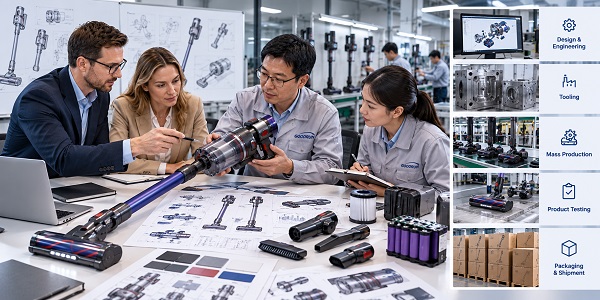
The OEM Vacuum Cleaner Development Process
Although every project is different, a typical OEM development process may follow these stages:
Step 1 — Product Requirement Definition
The buyer and manufacturer define:
- Target market
- Product positioning
- Performance requirements
- Target cost
- Expected volume
- Required features
↓
Step 2 — Technical Evaluation
The engineering team evaluates:
- Technical feasibility
- Existing product platforms
- Component options
- Development requirements
- Tooling requirements
↓
Step 3 — Quotation
The manufacturer prepares a quotation based on the agreed product specification.
↓
Step 4 — Product Design and Engineering
Depending on the project, this may include:
- Industrial design
- Mechanical design
- Electronic development
- Motor selection
- Battery configuration
- Accessory development
↓
Step 5 — Prototype Development
A functional prototype or sample is produced for evaluation.
↓
Step 6 — Testing and Optimization
The product may be evaluated for:
- Cleaning performance
- Suction
- Runtime
- Noise
- Temperature
- Charging
- Ergonomics
- Durability
↓
Step 7 — Tooling
New molds or tooling are developed where necessary.
↓
Step 8 — Certification and Compliance Testing
Testing is conducted according to the requirements of the target market.
↓
Step 9 — Pilot Production
A smaller production run may be used to identify potential manufacturing issues before full mass production.
↓
Step 10 — Mass Production
After final approval, the project moves into regular production.
↓
Step 11 — Quality Inspection
Finished products are inspected according to agreed quality requirements.
↓
Step 12 — Shipment
Products are packed and prepared for international shipment.
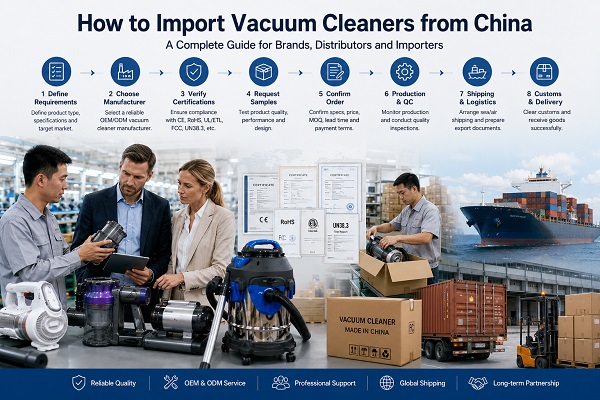
For buyers sourcing from China for the first time, see our complete importing guide.
How Long Does OEM Vacuum Cleaner Development Take?
There is no universal development timeline.
The schedule depends heavily on the amount of customization required.
A project based on an existing product platform with limited modifications may be completed relatively quickly.
A completely new product may require significantly more time for:
- Industrial design
- Engineering
- Prototypes
- Tooling
- Testing
- Certification
- Pilot production
Buyers should therefore discuss the development schedule before committing to a launch date.
Trying to shorten development by eliminating necessary validation stages can create much more expensive problems after mass production.
How Much Does OEM Vacuum Cleaner Development Cost?
OEM development cost depends on the scope of the project.
Potential costs include:
- Industrial design
- Mechanical engineering
- Electronics development
- Prototype development
- Tooling
- Mold development
- Components
- Testing
- Certification
- Packaging development
For projects using an existing platform, some of these costs may be reduced or eliminated.
For completely new products, development investment can be considerably higher.
Buyers should therefore evaluate:
Development Cost + Unit Cost + Certification + Tooling + Quality + Expected Sales Volume
rather than focusing only on the FOB unit price.
MOQ for OEM Vacuum Cleaners
OEM MOQ depends on several factors.
These can include:
- Product category
- Level of customization
- Motor requirements
- Battery requirements
- Plastic color
- Packaging
- Component MOQ
- Tooling
- Production efficiency
A product requiring highly customized components will generally have different MOQ requirements from a standard product with only branding changes.
Buyers should discuss both the initial order quantity and expected annual volume with the manufacturer.
This allows the factory to evaluate the project more accurately.
Certification and Compliance
Compliance should be considered during product development rather than after the product has already been finalized.
Requirements vary by country, product type and configuration.
For European markets, areas that may need consideration include:
- Electrical safety
- EMC
- RoHS
- Applicable environmental requirements
- Battery requirements
- Product labeling
For North American markets, buyers may need to consider applicable:
- Electrical safety requirements
- EMC requirements
- FCC requirements where relevant
- Battery requirements
Battery-powered products may also require appropriate documentation for transportation.
The exact requirements should be confirmed for the final product and destination market.
Quality Control in OEM Vacuum Cleaner Manufacturing
OEM projects require more than checking finished products immediately before shipment.
Quality management should begin with the components.
Incoming Quality Control
Important components may include:
- Motor
- Battery
- PCB
- Charger
- Plastic parts
- Filters
- Floorhead components
In-Process Quality Control
During production, manufacturers should monitor:
- Assembly
- Electrical performance
- Product function
- Appearance
- Component installation
Product Testing
Depending on the product, testing may include:
- Suction performance
- Airflow
- Runtime
- Charging
- Noise
- Temperature
- Floorhead operation
- Functional testing
Final Inspection
Before shipment, finished products should be checked against agreed specifications and quality standards.
Should You Visit the Vacuum Cleaner Factory?
For important OEM projects, a factory visit or professional audit can provide valuable information.
Buyers can evaluate:
- Production lines
- Engineering facilities
- Testing equipment
- Quality control
- Warehouse
- Component management
- Production capacity
- R&D capability
A factory visit also provides an opportunity for the buyer's product team and the manufacturer's engineering team to discuss the project directly.
If you are evaluating potential suppliers, see:
[How to Find a Reliable Vacuum Cleaner Manufacturer in China]
Common OEM Vacuum Cleaner Sourcing Mistakes
Several mistakes can create unnecessary development risk.
Choosing a Supplier Only by Price
The lowest quotation may not represent the lowest total business cost.
Consider:
- Quality
- Engineering
- Warranty
- Reliability
- Certification
- Communication
Starting Development Without a Clear Product Brief
Changing specifications repeatedly during development can increase both cost and lead time.
Define your priorities before the project begins.
Comparing Products Only by Specifications
Two products with similar specifications may provide very different real-world cleaning performance.
Physical sample testing is essential.
Ignoring Certification Until the End
Compliance problems discovered after tooling or production can be expensive to correct.
Certification should be considered from the beginning.
Skipping Pilot Production
For a highly customized product, moving directly from prototype to large-scale production can increase manufacturing risk.
A pilot run can help identify potential issues earlier.
How to Choose an OEM Vacuum Cleaner Manufacturer in China
When comparing manufacturers, evaluate more than the quotation.
A strong OEM partner should demonstrate:
Industry Experience
Does the manufacturer have proven experience in vacuum cleaners and floor care appliances?
R&D Capability
Can its engineers support mechanical, electrical and product-development requirements?
Manufacturing Capability
Does the factory have appropriate assembly, testing and production capacity?
Quality Control
Does the supplier have documented quality procedures?
Compliance Experience
Does the manufacturer understand your target market?
Supply Chain
Can the supplier reliably source motors, batteries, PCBs and other important components?
Communication
Can the project team communicate technical information clearly and respond quickly when problems arise?
Long-Term Support
Can the supplier support spare parts, product improvements and future product generations?
The objective is not simply to select a factory for one purchase order.
For established brands, the greater value often comes from developing a reliable long-term manufacturing and product-development partner.
Why Work with Goodrun for Vacuum Cleaner OEM Manufacturing?
Goodrun provides OEM and ODM solutions for brands, distributors and retailers developing vacuum cleaners and floor care appliances.
Our team has more than 20 years of experience in the floor care industry and can support projects from product selection and customization through engineering development and mass production.
Our product categories include:
- Cordless Vacuum Cleaners
- Corded Vacuum Cleaners
- Wet & Dry Vacuum Cleaners
- Spot Cleaners
- Steam Cleaners
- Dust Mite Vacuum Cleaners
- Other Floor Care Appliances
Depending on the project, our support can include:
- Product evaluation
- OEM customization
- ODM development
- Industrial design support
- Mechanical engineering
- Motor selection
- Battery configuration
- Floorhead development
- Prototype development
- Tooling
- Product testing
- Certification support
- Quality control
- Mass production
[Goodrun Vacuum Cleaner Products]
Frequently Asked Questions
What does OEM mean for vacuum cleaners?
OEM vacuum cleaner manufacturing means producing vacuum cleaners according to the buyer's product requirements, specifications and brand standards. The level of customization can range from modifications to an existing platform to development of a substantially new product.
Can I manufacture a vacuum cleaner with my own brand?
Yes. Branding can typically include your logo, product name, model number, packaging, user manual and product labels.
For simpler brand customization, see our Private Label Vacuum Cleaner Guide.
[Internal Link: Private Label Vacuum Cleaners]
Can an OEM manufacturer develop a completely new vacuum cleaner?
Yes, if the manufacturer has the necessary R&D and engineering capabilities. A new product may require industrial design, mechanical engineering, electronic development, prototypes, tooling, testing and certification.
Can I customize the motor and battery?
Depending on the product platform, motor and battery configurations can often be selected or developed according to performance, runtime, weight, target cost and compliance requirements.
What is the MOQ for OEM vacuum cleaners?
There is no universal MOQ. It depends on the product, components, customization level, packaging, tooling and production requirements.
How long does OEM vacuum cleaner development take?
The development schedule depends on the complexity of the project. Modifying an existing platform is generally faster than developing a completely new product requiring new tooling and certification.
What information should I provide when requesting an OEM quotation?
Ideally provide your target market, product category, specifications, required features, target price or positioning, estimated order quantity, certification requirements and expected launch date.
Should I choose OEM or ODM?
OEM is generally suitable when you already have defined product requirements or designs. ODM is more appropriate when you need the manufacturer to provide greater product-development support.
Final Thoughts
Successful vacuum cleaner OEM manufacturing is not simply a process of sending a specification to a factory and asking for the lowest price.
A successful project requires cooperation between the buyer and manufacturer across:
Product Strategy → Engineering → Components → Prototyping → Testing → Compliance → Manufacturing → Quality Control
For brands and distributors, the right OEM manufacturer should provide more than production capacity.
It should be able to understand your target market, translate product requirements into a manufacturable solution, identify technical risks before mass production and support consistent product quality over the long term.
If you are developing a new vacuum cleaner or looking for an OEM manufacturing partner in China, contact Goodrun to discuss your product concept, target market and technical requirements.