Cordless Vacuum Cleaner Buying Guide for Brands, Distributors & Retailers
Cordless vacuum cleaners have become an important category in the global floor care market. Their freedom from power cords, lightweight designs and increasing cleaning performance make them popular among consumers in Europe, North America and other markets.
For brands, distributors, retailers and importers, however, choosing the right cordless vacuum cleaner is more complicated than simply comparing suction power and price.
A successful cordless vacuum cleaner needs to balance cleaning performance, battery life, weight, noise, filtration, usability, reliability and retail price.
This guide explains the key factors buyers should evaluate when sourcing a cordless vacuum cleaner for their market.
1. Define Your Target Market First
Before selecting a cordless vacuum cleaner, determine who will buy the product and where it will be sold.
Different markets and consumer groups can have very different expectations.
For example:
Entry-Level Products
Suitable for:
- Value-oriented consumers
- Supermarkets
- Discount retailers
- Entry-level e-commerce products
The priorities are usually:
- Competitive price
- Basic cleaning performance
- Simple operation
- Reliable battery
- Attractive appearance
Mid-Range Products
Suitable for:
- Mainstream retailers
- E-commerce brands
- Private label brands
- Household appliance distributors
Important features may include:
- Higher suction performance
- Longer runtime
- Better filtration
- Motorized floor brush
- Multiple accessories
- Improved ergonomics
Premium Products
Premium cordless vacuum cleaners generally compete through:
- High cleaning performance
- Advanced brush technology
- Better filtration
- Premium industrial design
- Low noise
- Longer runtime
- Advanced user interface
- Automatic or intelligent functions
Before contacting a manufacturer, establish your target retail price and market positioning.
This will help determine the appropriate product configuration.
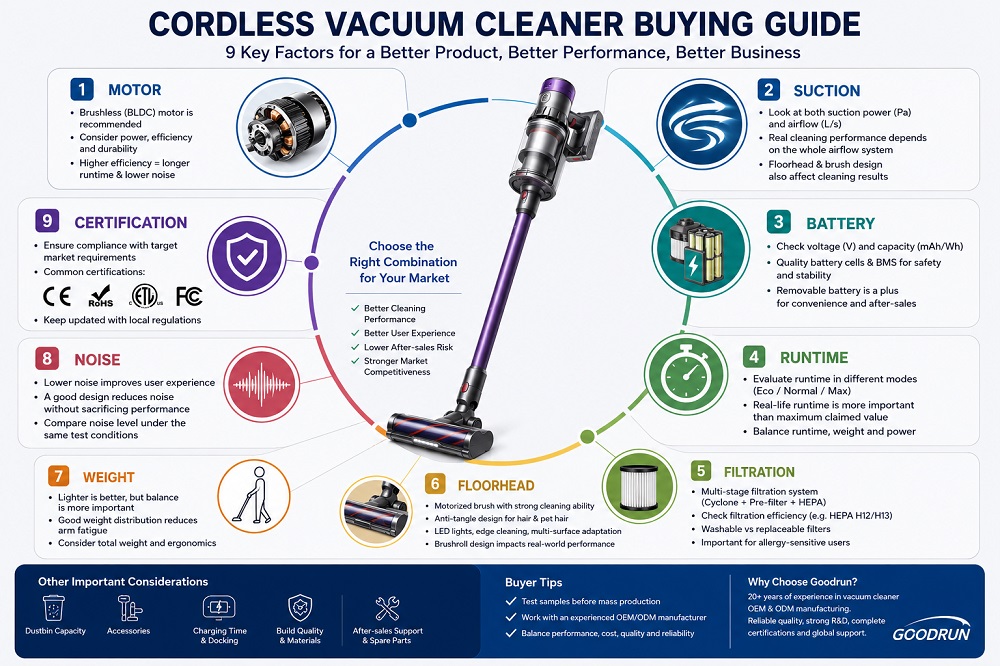
2. Suction Power: Don't Look at One Number Only
Suction performance is one of the most important specifications of a cordless vacuum cleaner.
However, buyers should not evaluate a product only by its advertised Pa value.
Actual cleaning performance is affected by multiple factors, including:
- Motor performance
- Airflow
- Vacuum pressure
- Floorhead design
- Brushroll design
- Air duct design
- Filtration resistance
- Dustbin design
A high maximum vacuum pressure does not automatically mean better cleaning performance.
For OEM and ODM projects, it is better to evaluate the complete airflow system rather than selecting a motor based solely on its maximum Pa specification.
What should buyers ask manufacturers?
Request information about:
- Maximum suction pressure
- Airflow
- Motor power
- Motor efficiency
- Performance under different operating modes
- Floorhead cleaning performance
This gives you a much better understanding of the actual product capability.
3. Battery Capacity and Runtime
Battery performance is one of the biggest differences between cordless and corded vacuum cleaners.
When evaluating a cordless vacuum, check:
- Battery voltage
- Battery capacity
- Battery chemistry
- Number of cells
- Battery management system
- Charging time
- Runtime
- Replaceability
Runtime should always be evaluated according to the operating mode.
For example, a vacuum cleaner may have significantly different runtime in:
- Eco mode
- Normal mode
- Max/Turbo mode
Therefore, avoid comparing products based only on a single "maximum runtime" number.
For example:
Up to 60 minutes runtime
may refer to a low-power mode without a motorized floor brush.
A more useful specification would provide runtime for different operating conditions.
4. Battery Weight vs Product Weight
Battery capacity directly affects the overall weight of a cordless vacuum cleaner.
More battery cells can provide greater energy capacity, but they also increase:
- Product weight
- Cost
- Charging requirements
- Handling fatigue
This creates an important engineering trade-off.
A premium cordless vacuum cleaner should balance:
Runtime + Suction Performance + Weight + Battery Capacity
rather than maximizing one specification.
For products designed for European and North American markets, ergonomics should be evaluated carefully because consumers may use the vacuum for extended cleaning sessions.
5. Replaceable or Removable Battery
A removable battery can provide several advantages.
For consumers
It allows users to:
- Replace an old battery
- Purchase a spare battery
- Extend cleaning time
- Charge the battery separately
For brands
A replaceable battery can create additional opportunities for:
- Spare battery sales
- Accessories
- After-sales service
- Product lifecycle extension
However, a removable battery can also increase product cost and require additional mechanical and electrical design.
Whether it is necessary depends on your target market and product positioning.
6. Filtration System
Filtration is another important factor when selecting a cordless vacuum cleaner.
A typical system may include:
- Pre-filter
- Cyclone separation system
- Fine filter
- HEPA filter or other high-efficiency filtration
Buyers should not evaluate filtration only by marketing terminology.
Ask the manufacturer for specific information about:
- Filter material
- Filtration efficiency
- Filter configuration
- Filter cleaning method
- Filter replacement cycle
- Available test reports
If your product is marketed for allergy-sensitive consumers, filtration performance should be supported by appropriate testing rather than unsupported marketing claims.
7. Dustbin Capacity
A larger dustbin reduces the frequency of emptying, but it can also increase product size and weight.
The appropriate capacity depends on the product positioning.
For example:
Lightweight cordless vacuum
A smaller dustbin can help reduce:
- Weight
- Product size
- Manufacturing cost
Family-size premium vacuum
A larger dustbin may provide a better user experience.
When developing an ODM product, dustbin capacity should be considered together with:
- Cyclone efficiency
- Filter design
- Product dimensions
- Weight distribution
8. Floorhead and Brushroll Design
The floorhead is one of the most important components affecting real-world cleaning performance.
A good floorhead should effectively remove:
- Dust
- Hair
- Pet hair
- Larger debris
- Fine particles
Different markets may require different brush configurations.
For example, products designed for homes with pets may benefit from a specialized anti-tangle brush.
Other important considerations include:
- Brushroll diameter
- Bristle configuration
- Motorized brush performance
- Anti-tangle design
- Edge cleaning
- LED headlights
- Floor compatibility
A manufacturer with strong engineering capability should be able to optimize the floorhead according to the target market.
9. Weight and Ergonomics
Weight is especially important for cordless vacuum cleaners because the user often holds the main body while cleaning.
Do not evaluate weight alone.
Consider:
- Total product weight
- Weight distribution
- Handle position
- Trigger/button design
- Center of gravity
- Floorhead weight
- Tube length
A slightly heavier vacuum can still feel comfortable if its weight distribution is well designed.
For this reason, ergonomic testing with physical samples is highly recommended before mass production.
10. Noise Level
Noise is increasingly important in the European and North American markets.
A cordless vacuum cleaner should ideally provide strong cleaning performance without excessive noise.
Noise is influenced by:
- Motor
- Airflow
- Fan design
- Air ducts
- Cyclone system
- Floorhead
- Housing structure
When comparing suppliers, ask how the noise level was measured.
The testing conditions should be consistent because noise measurements can vary depending on:
- Distance
- Operating mode
- Test environment
- Measurement equipment
A manufacturer should be able to provide meaningful test data rather than only a marketing claim.
11. Charging Time and Charging System
Charging convenience affects the overall user experience.
Common solutions include:
- Wall-mounted charging dock
- Floor-standing charging station
- Direct adapter charging
- Removable battery charging
- Charging and storage stations
For premium products, a wall-mounted or freestanding charging station can provide additional convenience and help improve product presentation.
For entry-level products, a simple adapter may be more appropriate to maintain a competitive price.
12. Accessories
Accessories can significantly increase the versatility of a cordless vacuum cleaner.
Common accessories include:
- Crevice tool
- Dusting brush
- Upholstery tool
- Motorized mini brush
- Pet brush
- Extension tube
- Wall mount
However, more accessories do not necessarily mean a better product.
The accessory package should match the target consumer and retail price.
For private label products, buyers should also consider:
- Accessory storage
- Packaging space
- Additional cost
- Replacement availability
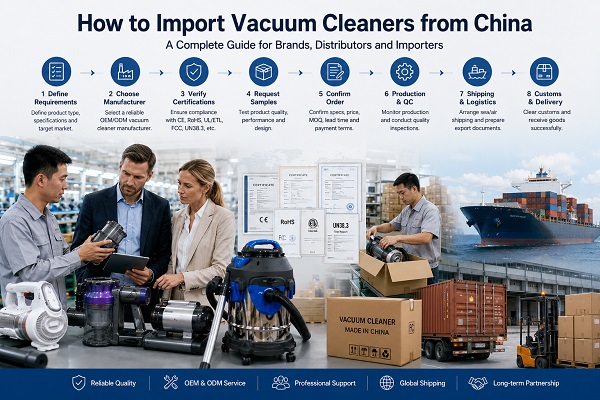
13. Product Certification and Compliance
Before importing cordless vacuum cleaners, confirm the applicable requirements for your target market.
For European markets, requirements may include areas such as:
- Electrical safety
- EMC
- RoHS
- Energy-related requirements where applicable
- Battery compliance and transport requirements
For North American markets, buyers may need to consider:
- Electrical safety certification
- EMC requirements
- FCC requirements for applicable products
- Battery transportation requirements
The exact compliance requirements depend on the product configuration and destination market.
Always confirm the applicable requirements with your testing laboratory or compliance specialist before mass production.
14. Quality Control
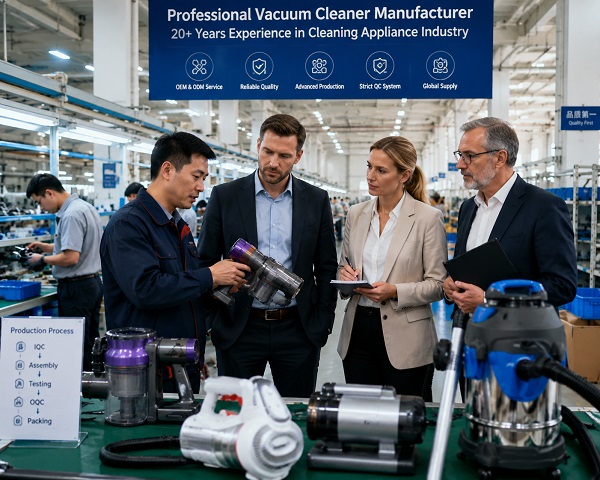
A reliable cordless vacuum cleaner manufacturer should have a structured quality control system.
Important stages include:
Incoming Quality Control
Components such as:
- Motors
- Batteries
- PCBs
- Plastic parts
- Filters
should be inspected before production.
Production Quality Control
The factory should monitor:
- Assembly
- Electrical performance
- Motor operation
- Battery charging
- Product appearance
Final Quality Control
Finished products should be tested before shipment.
Important tests may include:
- Function testing
- Charging testing
- Battery testing
- Suction testing
- Noise testing
- Appearance inspection
- Packaging inspection
15. OEM vs ODM for Cordless Vacuum Cleaners
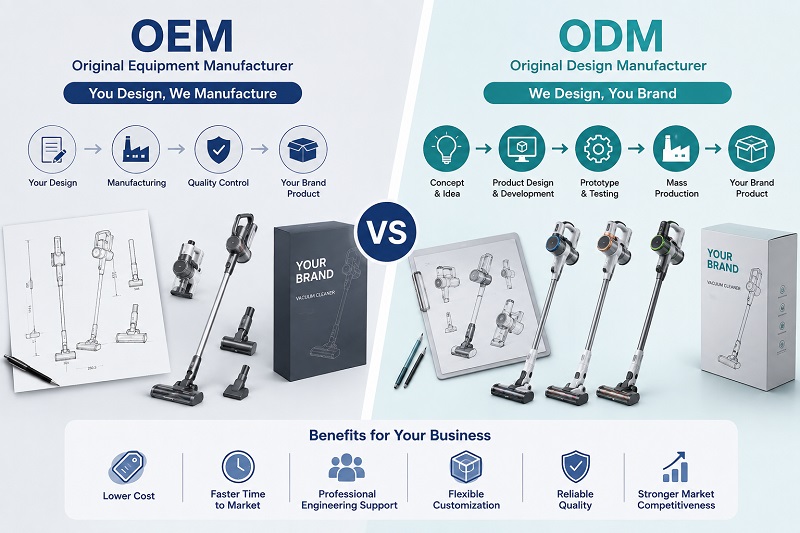
When sourcing a cordless vacuum cleaner, buyers normally have two major options.
OEM Cordless Vacuum Cleaner
OEM is suitable when you already have:
- Product specifications
- Industrial design
- Engineering requirements
- Branding requirements
The manufacturer focuses primarily on manufacturing according to your requirements.
ODM Cordless Vacuum Cleaner
ODM is suitable when you need support with:
- Product design
- Engineering
- Motor selection
- Battery configuration
- Floorhead development
- Prototype development
- Testing
- Certification
For brands and distributors that want to launch a cordless vacuum cleaner without developing everything internally, ODM can significantly simplify the process.
You can learn more in our OEM vs ODM Vacuum Cleaner guide.
16. How Much Does a Cordless Vacuum Cleaner Cost?
The final cost depends on many factors.
Major cost drivers include:
- Motor
- Battery
- PCB
- Floorhead
- Filtration system
- Housing
- Accessories
- Packaging
- Tooling
- Certification
- Order quantity
For this reason, comparing two products based only on FOB price can be misleading.
A better approach is to compare the total product value:
Performance + Quality + Features + Reliability + After-Sales Support + Cost
A slightly higher unit price may be justified if the product provides better performance and fewer warranty problems.
17. MOQ and Production Considerations
Before placing an order, confirm:
- MOQ
- Sample cost
- Sample lead time
- Mass production lead time
- Packaging requirements
- Spare parts availability
- Warranty terms
- Payment terms
- Shipping terms
If you are launching a new product, ask whether the manufacturer can support a pilot order before committing to large-scale production.
This can reduce your initial market risk.
18. Questions to Ask a Cordless Vacuum Cleaner Manufacturer
Before selecting a supplier, ask these questions:
Product
- What is the motor power?
- What is the maximum suction pressure?
- What is the airflow?
- What is the battery capacity?
- How many battery cells are used?
- What is the runtime in each mode?
- What is the charging time?
- What is the dustbin capacity?
- What filtration system is used?
- What accessories are included?
Manufacturing
- How many years have you manufactured cordless vacuum cleaners?
- Do you have your own R&D team?
- Do you provide OEM and ODM services?
- Can you customize the product?
- What is the MOQ?
- What is the production lead time?
Compliance
- Which certifications are available?
- Can you support certification for our target market?
- Can you provide test reports?
- What battery documentation is available?
Quality
- What is your quality control process?
- What product tests are performed before shipment?
- Can you provide inspection reports?
A professional manufacturer should be able to answer these questions clearly.
19. How to Choose the Right Cordless Vacuum Cleaner for Your Brand
The best cordless vacuum cleaner is not necessarily the one with the highest suction power or longest advertised runtime.
Instead, the product should match your:
Target Consumer
↓
Target Market
↓
Retail Price
↓
Performance Requirements
↓
Feature Set
↓
Certification Requirements
↓
Production Cost
↓
Long-Term Business Strategy
For example, a €99 retail product requires a very different configuration from a €399 premium cordless vacuum cleaner.
The manufacturer should help you find the right balance between performance and cost.
Why Choose Goodrun for Cordless Vacuum Cleaner OEM & ODM?
Goodrun provides OEM and ODM manufacturing solutions for brands, distributors and retailers looking for cordless vacuum cleaners and other floor care appliances.
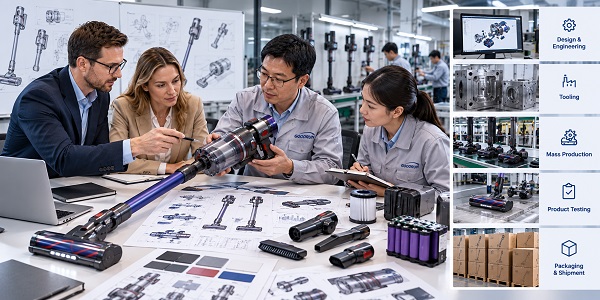
Our capabilities cover the development and manufacturing process from product concept through mass production.
Our support can include:
- Cordless vacuum cleaner development
- OEM manufacturing
- ODM development
- Product customization
- Industrial design support
- Mechanical engineering
- Motor and battery configuration
- Floorhead development
- Prototype development
- Product testing
- Certification support
- Quality control
- Mass production
Our broader floor care product portfolio also includes corded vacuum cleaners, wet & dry vacuum cleaners, spot cleaners, steam mops and dust mite cleaners.
For companies looking to build or expand a private label floor care product range, working with one experienced manufacturing partner can simplify product development and supply chain management.
Frequently Asked Questions
What is a good suction power for a cordless vacuum cleaner?
There is no single suction specification that guarantees good cleaning performance. Buyers should consider suction pressure together with airflow, floorhead design, brushroll performance and filtration resistance.
How long should a cordless vacuum cleaner run?
The required runtime depends on the target market and product positioning. Runtime should be evaluated separately for Eco, Normal and Max modes rather than relying only on the maximum advertised runtime.
Is a removable battery better?
A removable battery can make replacement and extended cleaning more convenient, but it can also increase product cost and complexity. The decision should depend on the product positioning and target market.
What should I look for in a cordless vacuum cleaner manufacturer?
Look for proven manufacturing experience, strong R&D capability, reliable quality control, international compliance experience and the ability to provide OEM or ODM support.
Can I customize a cordless vacuum cleaner with my own brand?
Yes. Professional OEM/ODM manufacturers can typically customize branding, color, packaging, accessories and, depending on the project, technical specifications and product design.
How much does a cordless vacuum cleaner cost?
The cost depends on motor, battery, floorhead, filtration, accessories, customization, certification and order quantity. Buyers should compare the complete product configuration rather than unit price alone.
Final Thoughts
Choosing a cordless vacuum cleaner for your brand is not simply a matter of finding the highest suction power at the lowest price.
A commercially successful product needs the right combination of:
Cleaning Performance + Battery Runtime + Weight + Filtration + Ergonomics + Reliability + Cost
The most important step is finding a manufacturer that understands these trade-offs and can help you develop a product specifically for your target market.
For brands, distributors and retailers, an experienced cordless vacuum cleaner OEM/ODM manufacturer can provide not only production capacity, but also engineering expertise, product customization and long-term development support.
Looking for a cordless vacuum cleaner supplier for your next private label project? Contact Goodrun to discuss your product requirements.