Private Label Vacuum Cleaners: A Complete Guide for Brands and Distributors
Launching a vacuum cleaner under your own brand does not necessarily require you to design and manufacture the product yourself.
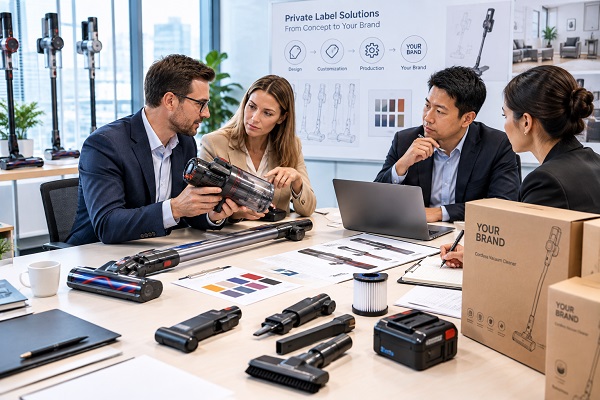
For brands, distributors, importers and retailers, private label vacuum cleaners provide a practical way to enter the floor care market using an experienced manufacturer's product platform and production capabilities.
Depending on your requirements, you can choose an existing vacuum cleaner and customize the branding and packaging, modify an existing product platform, or develop a more customized product with an OEM or ODM manufacturer.
This guide explains how private label vacuum cleaner manufacturing works and what buyers should consider before selecting a supplier.
What Is a Private Label Vacuum Cleaner?
A private label vacuum cleaner is a vacuum cleaner manufactured by a third-party manufacturer and sold under the buyer's own brand.
Instead of investing in an entire manufacturing facility, the brand works with a professional vacuum cleaner manufacturer to produce the product.
Depending on the project, customization may include:
- Brand logo
- Product color
- Product appearance
- Packaging
- User manual
- Accessories
- Product configuration
- Electrical specifications
- Battery configuration
- Floorhead
- Filtration system
Private label manufacturing can therefore range from relatively simple branding and packaging customization to substantial product development.
For companies that want to understand the difference between manufacturing models, see our guide:
Why Choose Private Label Vacuum Cleaners?
Private label manufacturing can offer several advantages compared with developing and manufacturing a vacuum cleaner completely in-house.
1. Faster Market Entry
Developing a completely new floor care product requires industrial design, engineering, prototyping, tooling, testing and production preparation.
An existing product platform can significantly reduce the time required to bring a product to market.
This can be particularly useful for new brands and distributors testing a new product category.
2. Lower Initial Development Investment
Developing a completely new vacuum cleaner can require significant investment in:
- Industrial design
- Engineering
- Prototypes
- Tooling
- Testing
- Certification
- Production setup
Using an existing product platform may reduce some of these initial development requirements.
The actual investment depends on the level of customization and the product development scope.
3. Brand Ownership
Private label allows companies to build their own brand instead of selling products under another manufacturer's brand.
The product can be presented with your:
- Brand name
- Logo
- Packaging
- Product photography
- Marketing materials
- User manual
- Retail positioning
This gives brands greater control over their market positioning.
4. Flexible Product Positioning
Different products can be developed for different retail price points.
For example:
Entry-Level
Focus on:
- Competitive pricing
- Basic functionality
- Simple configuration
Mid-Range
Focus on:
- Better cleaning performance
- Longer runtime
- Improved filtration
- More accessories
- Better ergonomics
Premium
Focus on:
- Advanced product design
- High cleaning performance
- Premium materials
- Advanced floorhead technology
- Longer runtime
- Enhanced user experience
A good manufacturing partner should be able to help you balance product features and target cost.
Private Label vs OEM vs ODM
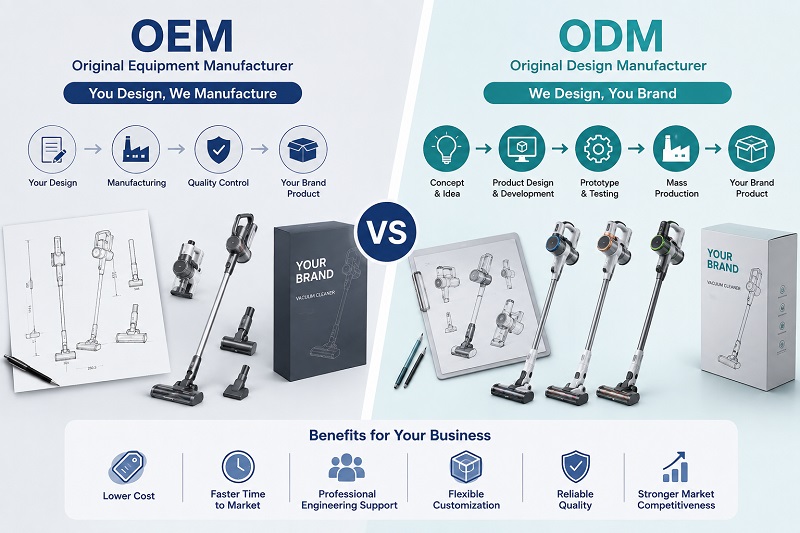
These terms are often used interchangeably, but they can represent different levels of product development.
| Manufacturing Model | Product Development | Customization | Typical Buyer |
|---|---|---|---|
| Private Label | Mainly manufacturer | Low–Medium | New brands, retailers |
| OEM | Buyer or shared | High | Established brands |
| ODM | Manufacturer or shared | Medium–High | Brands needing development |
| Customized ODM | Shared | High | Brands seeking differentiated products |
Private Label
You select an existing product and add your own branding and packaging.
OEM
You provide your product specifications, design or requirements and the manufacturer produces the product accordingly.
ODM
The manufacturer provides product development and engineering support, often based on an existing platform or a new product concept.
Customized ODM
You start with an existing product platform but make meaningful changes to create a product better suited to your brand and market.
For a more detailed comparison:
What Types of Vacuum Cleaners Can Be Private Labeled?
Private label manufacturing is not limited to one type of vacuum cleaner.
Depending on the manufacturer's product portfolio, brands can consider several categories.
Cordless Vacuum Cleaners
Cordless stick vacuum cleaners are suitable for brands targeting consumers who value convenience, flexibility and easy storage.
Important specifications include:
- Motor performance
- Suction pressure
- Airflow
- Battery capacity
- Runtime
- Charging time
- Dustbin capacity
- Filtration
- Floorhead design
- Product weight
For a detailed purchasing guide:
Cordless Vacuum Cleaner Buying Guide
Corded Vacuum Cleaners
Corded vacuum cleaners remain relevant for markets and consumers that prioritize continuous operation and competitive pricing.
Potential configurations include:
- Stick vacuum cleaners
- Canister vacuum cleaners
- Upright-style products
- Compact household vacuum cleaners
Wet & Dry Vacuum Cleaners
Wet & dry vacuum cleaners are designed for applications where both liquid and dry debris need to be handled.
They can be suitable for:
- Household cleaning
- Garages
- Workshops
- Commercial applications
- Hard-floor cleaning
Spot Cleaners
Portable spot cleaners can be positioned for cleaning:
- Sofas
- Carpets
- Mattresses
- Car interiors
- Pet-related stains
They can also be attractive products for private label brands looking to expand their floor care portfolio.
Steam Mops
Steam mops combine floor cleaning with steam-based cleaning technology.
Depending on the design, brands may customize:
- Product appearance
- Steam configuration
- Accessories
- Water tank
- Cleaning head
- Packaging
Dust Mite Vacuum Cleaners
Dust mite cleaners are designed for targeted cleaning of mattresses, sofas and other fabric surfaces.
They can be positioned as complementary products within a broader floor care portfolio.
What Can You Customize?
The level of customization depends on the product platform, engineering requirements and production quantity.
1. Logo and Branding
The simplest private label project usually starts with branding.
Possible options include:
- Product logo
- Model number
- Brand name
- Product labels
- Rating labels
2. Product Color
Color customization can help the product match your brand identity.
Common options include:
- Housing color
- Decorative color
- Handle color
- Brushroll color
- Accent colors
Color selection should be confirmed with the manufacturer because different materials and finishes may require different production processes.
3. Packaging
Packaging is particularly important for retail products.
Private label packaging may include:
- Retail box
- Color carton
- Shipping carton
- User manual
- Product labels
- Safety information
- Product photography
A well-designed package should communicate the product's main selling points while complying with applicable market requirements.
4. Accessories
Brands can sometimes customize the accessory package according to their target customers.
Examples include:
- Crevice tool
- Dusting brush
- Upholstery tool
- Motorized mini brush
- Pet brush
- Extension tube
- Wall mount
- Charging accessories
Adding more accessories is not always better.
The accessory package should support the product's positioning without unnecessarily increasing product cost.
Can You Customize the Technical Configuration?
Yes, depending on the product platform and manufacturer's engineering capabilities.
Technical customization may include:
Motor
- Motor type
- Motor power
- Performance configuration
Battery
- Battery voltage
- Battery capacity
- Cell configuration
- Battery management system
Suction System
- Airflow
- Suction pressure
- Air duct design
- Cyclone system
Filtration
- Pre-filter
- Fine filter
- HEPA or high-efficiency filtration
- Filter configuration
Floorhead
- Brushroll
- Motorized brush
- Anti-tangle design
- LED lighting
- Floor compatibility
However, technical changes can increase development costs, tooling requirements and testing requirements.
For this reason, technical customization should be discussed with the manufacturer before finalizing the product.
How Much Does a Private Label Vacuum Cleaner Cost?
There is no single price for a private label vacuum cleaner.
The final cost depends on the complete product configuration and project requirements.
Major cost factors include:
- Product type
- Motor
- Battery
- Floorhead
- Filtration system
- Accessories
- Product materials
- Packaging
- Customization
- Tooling
- Certification
- Order quantity
A simple private label project based on an existing product may have a very different cost structure from a completely new ODM product.
Therefore, buyers should evaluate the total product cost, rather than comparing suppliers based only on the initial unit price.
For more information about sourcing and importing:
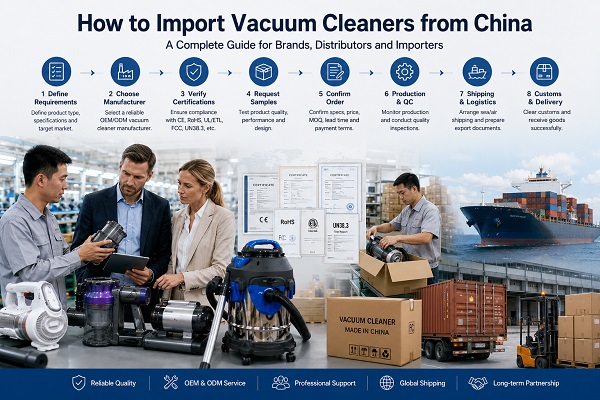
How to Import Vacuum Cleaners from China
What MOQ Should You Expect?
MOQ means Minimum Order Quantity.
The MOQ for private label vacuum cleaners depends on several factors, including:
- Existing product platform
- Product customization
- Packaging requirements
- Color customization
- Tooling
- Component requirements
- Production planning
An existing product with standard components may have a different MOQ from a completely customized product.
Before requesting a quotation, buyers should provide as much information as possible about:
- Target market
- Product type
- Target price
- Estimated annual volume
- Required customization
- Packaging requirements
This allows the manufacturer to recommend a more appropriate solution.
How Long Does It Take to Launch a Private Label Vacuum Cleaner?
The development timeline depends on the level of customization.
A typical project may follow this process:
Product Selection
↓
Specification Confirmation
↓
Customization
↓
Sample Development
↓
Testing & Approval
↓
Packaging Design
↓
Certification
↓
Mass Production
↓
Inspection
↓
Shipment
An existing product with limited customization can normally move through this process more quickly than a completely new product.
For new product development, additional time may be required for engineering, prototypes, tooling and testing.
How to Choose a Private Label Vacuum Cleaner Manufacturer
Choosing the right supplier is one of the most important decisions in a private label project.
A low factory price does not necessarily mean a lower total cost.
A reliable manufacturing partner should provide a combination of:
Manufacturing Experience
Look for a supplier with proven experience in vacuum cleaners and floor care products.
R&D Capability
If you need customization or product development, evaluate whether the manufacturer has its own engineering and R&D capabilities.
Quality Control
Ask how the supplier manages:
- Incoming inspection
- Production inspection
- Functional testing
- Final inspection
- Packaging inspection
Certification Experience
The supplier should understand the compliance requirements applicable to your target market.
Production Capacity
Confirm:
- MOQ
- Production capacity
- Lead time
- Component supply
- Quality consistency
Communication
Clear communication is essential during product development.
A supplier should be able to provide clear answers about specifications, samples, production and testing.
For a more detailed supplier selection guide:
How to Find a Reliable Vacuum Cleaner Manufacturer in China
Private Label Vacuum Cleaners for European and North American Markets
Brands selling vacuum cleaners in Europe and North America should consider market-specific compliance requirements from the beginning of the project.
Depending on the product and destination market, buyers may need to consider areas such as:
- Electrical safety
- EMC
- RoHS
- Battery requirements
- Product labeling
- Packaging requirements
- Environmental requirements
- Transportation requirements
The exact requirements depend on the final product configuration and destination country.
It is important to confirm the applicable requirements before mass production rather than waiting until the product is ready to ship.
A manufacturer with experience serving international markets can help coordinate product testing and certification, but buyers should also work with appropriate testing laboratories or compliance professionals when necessary.
Private Label Vacuum Cleaner Quality Control
Quality control should begin before mass production.
A professional supplier should have quality procedures covering the entire manufacturing process.
Incoming Material Inspection
Components such as motors, batteries, PCBs, plastic parts and filters should be inspected before production.
Production Inspection
The production process should be monitored for:
- Assembly quality
- Electrical performance
- Product appearance
- Component installation
- Functional performance
Final Inspection
Finished products should be checked before shipment.
Depending on the product, testing may include:
- Function testing
- Charging testing
- Battery testing
- Suction testing
- Noise testing
- Appearance inspection
- Packaging inspection
Private Label Vacuum Cleaner Development: A Practical Approach
For many brands and distributors, the most efficient approach is not to develop every component from scratch.
Instead, consider a staged approach.
Stage 1 — Select an Existing Product
Choose a proven vacuum cleaner platform that matches your target market.
Stage 2 — Define Your Market Position
Determine:
- Target retail price
- Target consumer
- Required performance
- Key selling points
- Product appearance
Stage 3 — Customize the Product
Customize the appropriate combination of:
- Logo
- Color
- Packaging
- Accessories
- Product specifications
Stage 4 — Sample and Test
Review the physical sample and verify:
- Performance
- Ergonomics
- Appearance
- Noise
- Battery performance
- Accessories
Stage 5 — Certification and Production
Complete the required testing and certification before moving into mass production.
This approach can reduce unnecessary development risk while still allowing meaningful product differentiation.
Should You Use an Existing Product or Develop a New One?
This is an important decision for brands.
Use an Existing Product If:
- You want faster market entry.
- Your target price is already clear.
- You do not need major design changes.
- You want to reduce initial development costs.
- You are testing a new market.
Develop a Customized Product If:
- You need stronger differentiation.
- You have specific technical requirements.
- Your brand has an established market position.
- You have a clear product concept.
- You expect significant sales volume.
Develop a Completely New Product If:
- Existing products cannot meet your requirements.
- You need proprietary design.
- You require significant technical differentiation.
- You have sufficient development budget and volume potential.
The right choice depends on your commercial strategy rather than simply the lowest development cost.
What Should You Ask a Private Label Vacuum Cleaner Supplier?
Before placing an order, ask the supplier for clear answers to the following questions.
Product
- What vacuum cleaner platforms are available?
- What is the motor specification?
- What is the suction performance?
- What is the battery capacity?
- What is the runtime?
- What filtration system is used?
- What accessories are included?
Customization
- Can the logo be customized?
- Can the product color be changed?
- Can the packaging be customized?
- Can the accessories be changed?
- Can technical specifications be modified?
Manufacturing
- What is the MOQ?
- What is the sample lead time?
- What is the mass production lead time?
- What is the production capacity?
- What quality control procedures are used?
Compliance
- What certifications are available?
- Which markets has the product been tested for?
- Can the manufacturer support additional certification?
- What battery documentation is available?
Commercial
- What are the payment terms?
- What are the shipping terms?
- What is the warranty policy?
- Are spare parts available?
A professional supplier should be able to provide clear and consistent answers.
Why Goodrun for Private Label Vacuum Cleaners?
Goodrun provides OEM and ODM vacuum cleaner manufacturing solutions for brands, distributors, retailers and importers.
Our product portfolio covers a range of floor care categories, including:
- Cordless Vacuum Cleaners
- Corded Vacuum Cleaners
- Wet & Dry Vacuum Cleaners
- Spot Cleaners
- Steam Mops
- Dust Mite Cleaners
- Other Floor Care Appliances
Our OEM and ODM support can include:
- Product selection
- Product customization
- Industrial design support
- Engineering development
- Prototype development
- Motor and battery configuration
- Floorhead development
- Packaging customization
- Product testing
- Certification support
- Quality control
- Mass production
Whether you are launching a new private label brand or expanding an existing floor care product range, Goodrun can work with you to develop a product solution according to your target market, specifications and commercial requirements.
Frequently Asked Questions About Private Label Vacuum Cleaners
What is a private label vacuum cleaner?
A private label vacuum cleaner is manufactured by a third-party manufacturer and sold under the buyer's own brand. The buyer can typically customize branding, packaging and, depending on the project, product configuration.
Can I put my own logo on a vacuum cleaner?
Yes. Logo customization is one of the most common private label requirements. The available branding method depends on the product materials and design.
Can I customize the color and packaging?
Yes. Product color and packaging can often be customized, subject to MOQ, production requirements and product specifications.
Can I customize a cordless vacuum cleaner?
Yes. Depending on the product platform, customization may include the battery, motor configuration, floorhead, accessories, filtration, product appearance and packaging.
For more information:
Cordless Vacuum Cleaner Buying Guide
What is the difference between private label and ODM?
Private label usually refers to selling an existing manufacturer's product under your own brand with relatively limited customization. ODM involves a greater level of product development and engineering support from the manufacturer.
What is the minimum order quantity for private label vacuum cleaners?
MOQ depends on the product, customization level, packaging, color, tooling and production requirements. Buyers should confirm MOQ with the manufacturer for the specific project.
How long does it take to develop a private label vacuum cleaner?
The timeline depends on the product and customization level. Existing products with simple branding can generally be prepared faster than completely new products requiring engineering, tooling, testing and certification.
Can private label vacuum cleaners be sold in Europe and the USA?
Yes, but the product must meet the applicable requirements of the destination market. The specific compliance requirements depend on the product configuration and country.
Final Thoughts
Private label vacuum cleaners provide brands, distributors and retailers with a practical way to enter or expand in the floor care market without building their own manufacturing infrastructure.
The key is to select the right product platform and the right level of customization.
For a simple market launch, an existing product with customized branding and packaging may be sufficient.
For stronger differentiation, a customized ODM solution may provide a better balance between development investment, product uniqueness and time to market.
For established brands with their own product concepts and technical requirements, OEM manufacturing or completely customized development may be more appropriate.
The most important factor is finding a manufacturing partner with the right combination of product experience, R&D capability, quality control, certification experience and production capacity.
If you are looking for a private label vacuum cleaner manufacturer in China, Goodrun can discuss your product requirements and recommend suitable OEM or ODM solutions.